> For the complete documentation index, see [llms.txt](https://docs.tomat.ai/llms.txt). Markdown versions of documentation pages are available by appending `.md` to page URLs; this page is available as [Markdown](https://docs.tomat.ai/data-transformation/transforms/group-by.md).
# Group By
Groups rows and calculate aggregation functions
## Overview
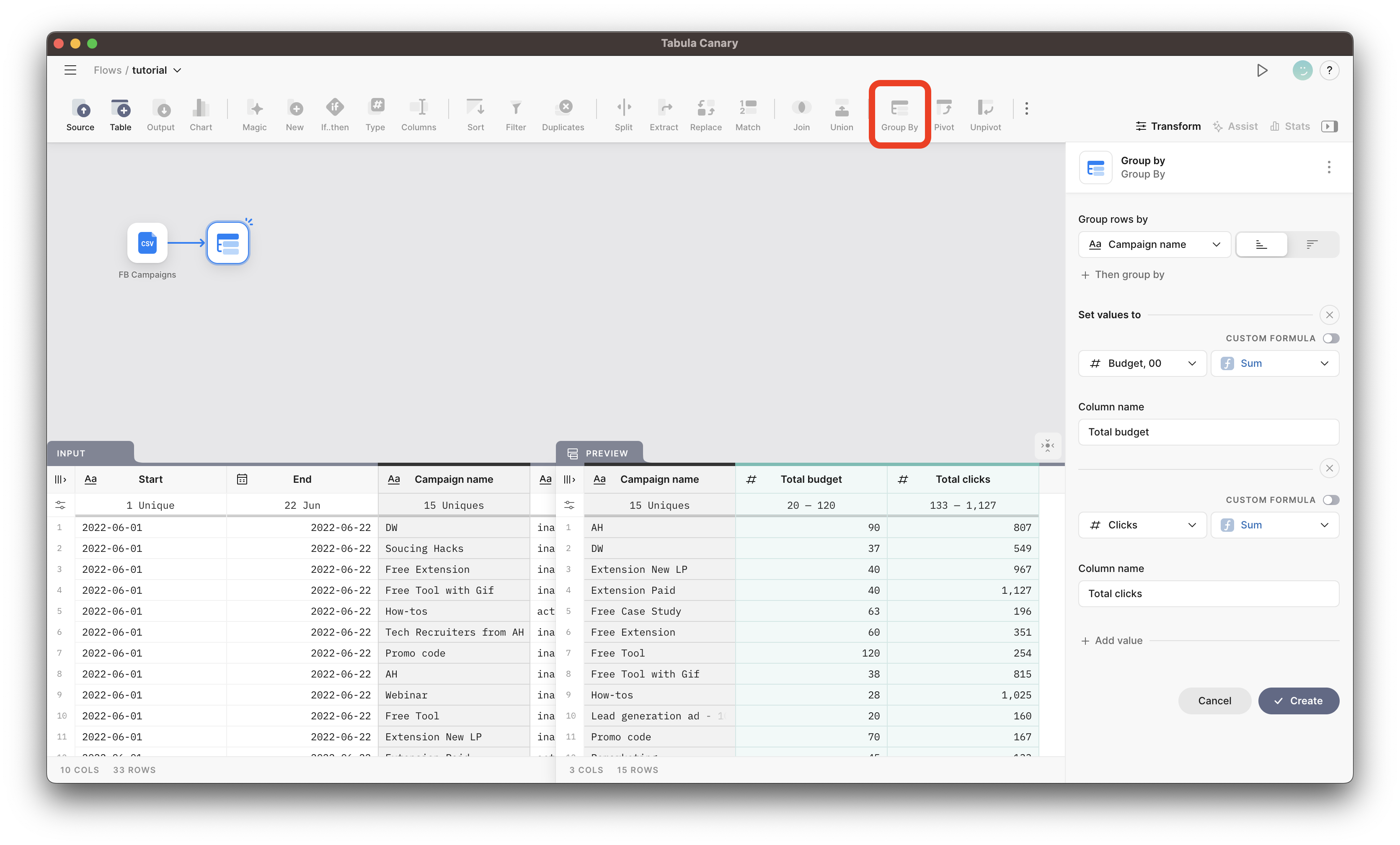
The Group By Node allows you to easily group your data by one or more columns and perform various aggregate functions such as sum, average, or count. This functionality is crucial for generating summarized views of your data and is often a vital step before further analysis or visualization.
## Settings
#### Group rows by
Select a column to group by. To choose multiple columns, click the "+ Then group by" link and select another one. Additionally, you can tailor the sorting order for each column individually.
#### Set values to
Select columns to perform aggregation. You can select multiple columns with the "+ Add value" link.
{% hint style="info" %}
Read more about the available aggregation functions [here](/data-transformation/formulas/aggregate-functions.md).
{% endhint %}
There are two options for creating aggregations:
1. Predefined aggregation functions. Follow these steps:
1. Select the column you want to use as a basis for the aggregation.
2. Choose an aggregation function from the list.
2. Custom Formula. Enable the "Custom Formula" toggle to use a custom formula. With this option, you can define any custom expression that should return an aggregation function.